


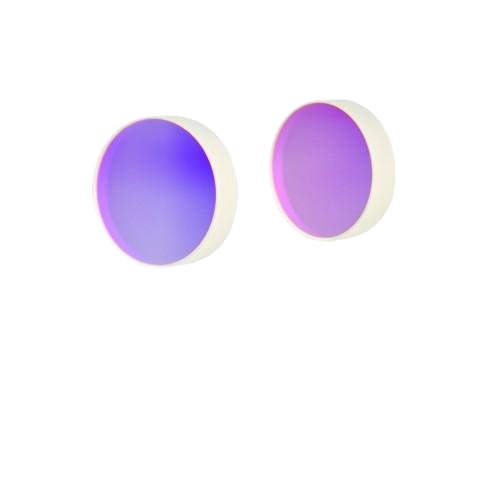


Product Description
l Low Group Delay Dispersion Dielectric Coating, Using Ion Beam Sputtering (IBS) Process
l Wavelength Range from 460 nm to 1700 nm
l Lower Thermal Expansion Coefficient and Extremely High Thermal Shock Stability
l Suitable for High-power Femtosecond Pulse Lasers and Imaging Applications
l Designed for 45° Incidence
The substrate material of Tuniu ultrafast mirrors is fused silica, with a high-reflectivity coating on the surface that consists of low group delay dispersion dielectric films, deposited using ion beam sputtering (IBS) technology. During the ion beam sputtering process, a high-energy electric field accelerates the ion beam toward the target, causing ions to be sputtered from the target and release more ions, which ultimately deposit as a coating on the rotating substrate. The use of ion beam sputtering enables high repeatability in batch coating and low coating thickness errors, ensuring the designed wavelength range and low group delay dispersion. Fused silica has a lower coefficient of thermal expansion and extremely high thermal shock stability, making it particularly suitable for high-power femtosecond pulse lasers and imaging applications. Note: The direction indicated by the side marking arrow points to the coated surface. Tuniu ultrafast mirrors are available in four working wavelength ranges: 460 nm–590 nm, 700 nm–930 nm, 970 nm–1150 nm, and 1400 nm–1700 nm. With a 45° angle of incidence, the reflectivity exceeds 99.5%.
Attributes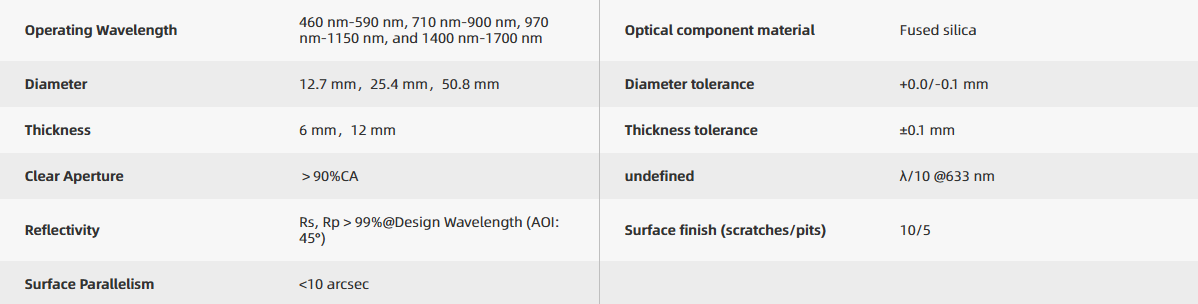
Ultra-fast Steering Mirrors
Tuniu ultrafast mirrors are commonly used for optical path deflection. Fused silica has a lower coefficient of thermal expansion and extremely high thermal shock stability, making ultrafast mirrors particularly suitable for high-power femtosecond pulse lasers and imaging applications. Meanwhile, Tuniu ultrafast mirrors support beam incidence at 45° with a reflectivity of over 99%.

Email:sales@tuniutech.com


